Discover how automated bonding systems are revolutionizing the manufacturing of fiber composite components and why MICADO is among the leading providers of customized bonding solutions.
.jpeg)
In the aerospace and automotive industries, manufacturing faces a central challenge: How can highly complex fiber composite components be joined economically, reproducibly, and with the highest quality? Traditional joining methods like riveting or welding reach their limits with modern lightweight materials such as CFRP and GFRP. The answer lies in automated bonding systems. Unlike manual bonding processes, automated systems ensure consistent quality across the entire production batch. Robot-assisted dispensing and application technology enables reproducible adhesive beads with exact geometry, defined quantity, and precise positioning – particularly critical for safety-relevant components in aerospace.
What are Automated Bonding Systems?
.jpeg)
Automated Bonding refers to the robot-assisted, precise application of adhesives to components. This technology is crucial for fiber composite materials, as these materials are sensitive to mechanical joining techniques. MICADO offers customized systems for the most demanding applications with significant advantages: Reproducible adhesive application with consistent quality, automatic monitoring of adhesive quantity and bead geometry, integrated inline inspection systems, and complete traceability. Additionally, they offer reduced cycle times, minimized material waste through precise dosing, and higher plant utilization. The systems adapt to various component geometries and can be integrated into existing production lines – scalable from semi-automation to full automation.
The Advantages of Automated Bonding Systems from MICADO
Adhesive Systems and Surface Pre-treatment
Selecting the appropriate adhesive system is crucial. Epoxy resin adhesives are the first choice for structural bonding in aerospace, offering extremely high shear strengths and temperature resistance up to 180 °C. Methyl methacrylate (MMA) adhesives combine high strengths with extremely short curing times – ideal for short cycle times in series production. Polyurethane adhesives offer maximum flexibility for sandwich elements, providing stress equalization and vibration damping.
Fiber composite materials must be absolutely free of dust and grease. Automated systems integrate mechanical pre-treatment through grinding or blasting, chemical pre-treatment via plasma activation or primer application, as well as quality control through surface energy measurement. This ensures reproducible conditions and optimal adhesion.
Robot-assisted Application and Quality Assurance
MICADO relies on state-of-the-art 6-axis robots with high-precision dispensing systems for precise adhesive application. All components used are designed to apply adhesives reliably and reproducibly with consistent quality. Modern electro-volumetric dispensers enable a dosing accuracy of ± 1% and ensure a constant material volume during operation. Pressure compensation balances viscosity fluctuations, while temperature control systems maintain consistent adhesive viscosity even during continuous operation. Multi-component mixing heads ensure homogeneous 2K adhesives during application. 3D path planning enables the precise application of complex bead geometries on curved surfaces, while speed-adaptive dispensing ensures consistent bead width during operation. Paths are programmed via teach-in or CAD import, and automatic collision avoidance reliably protects the system during operation.
A key advantage is the integrated quality control. High-resolution camera systems inspect the adhesive bead immediately after application for completeness, position, width, and geometry. Laser triangulation sensors measure bead height and applied volume. Continuous monitoring of pressure, flow, and temperature detects process deviations in real time. All parameters are documented, providing full traceability.
Holistic solutions from semi- to full automation
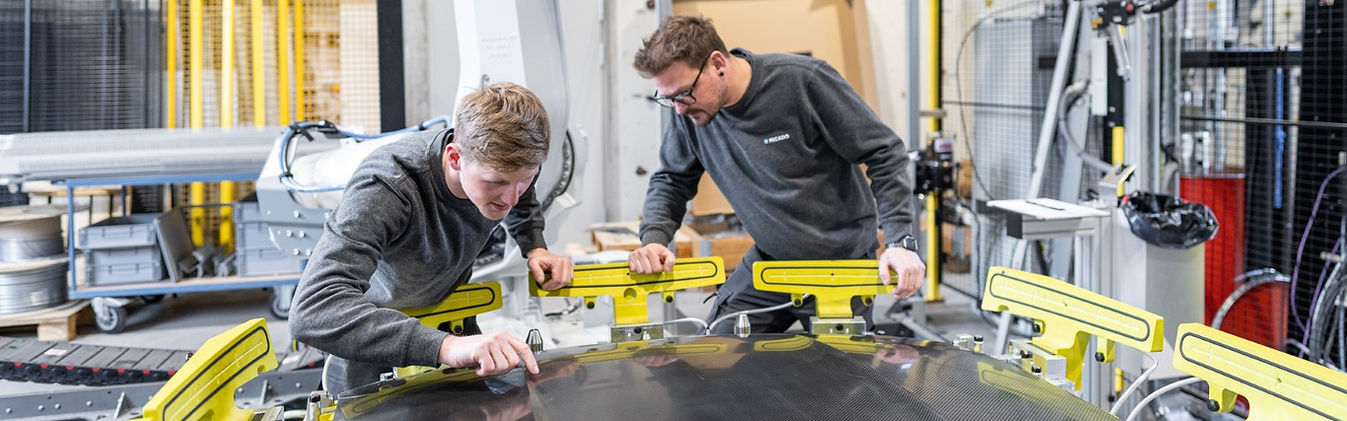
MICADO also offers semi-automatic solutions that combine human flexibility with machine precision. In human-robot collaboration, the employee handles the component, while the robot performs the precise adhesive application – particularly effective for medium production volumes.
Curing time often dictates cycle time. Modern systems integrate intelligent curing concepts: Temperature-controlled fixtures accelerate curing through controlled heat input, circulating buffer systems enable parallel curing, and IR or induction heating for localized rapid curing reduces cycle time.
Automated Bonding – Practical Examples
.jpeg)
In the aerospace industry, automated bonding systems are used for the assembly of fuselage segments, wing structures, and interior linings. Especially with large-area CFRP sandwich structures, uniform adhesive distribution is critical. MICADO systems ensure reproducible quality for large component dimensions.
In the automotive sector, battery housings made of fiber composite materials are a growing application area. The bonding must be electrically insulating, thermally conductive, and crash-proof. Automated systems enable precise application of special thermal pastes and structural adhesives. CFRP roofs for high-performance vehicles are also increasingly bonded automatically.
Customer Example SGL CARBON: From Challenge to Solution
MICADO as a Competent Partner for Successful Project Implementation
"Automated bonding is much more than just a robot with a glue gun" emphasizes Eng. Markus Rath, Head of Tool & Fixture Construction at MICADO.
Successful implementation requires a deep understanding of materials, adhesives, and processes. "The right solution depends on the component's shape and material, as well as the adhesive used. Cycle time, production volume, quality requirements, and budget also play a crucial role."
From the initial feasibility study to ongoing production, MICADO supports as a full-service provider: First, we analyze the process and test the materials. Based on this, we select the appropriate adhesive. Then, we develop the suitable automation solution. After that, we design the necessary fixtures and robot cells in detail. This is followed by programming and the development of the human-machine interface (HMI). After precise manufacturing and assembly, we commission the system and support process approval. Even after project completion, we continue to provide support.
Automated bonding systems make a significant contribution to sustainability: Reduced material consumption through precise dosing, minimization of waste through process reliability, energy efficiency through optimized curing concepts, and enabling lightweight construction with CO₂ savings during operation.
Conclusion
Automated bonding of fiber composite materials is a key technology for the future of industrial lightweight construction. With its expertise as a full-service provider for automation and fixture construction, MICADO supports companies in finding and successfully implementing the optimal bonding solution. Whether a fully automated production line or a semi-automatic individual cell – MICADO develops the solution that fits your requirements and creates sustainable added value in your manufacturing.
Interested in a consultation on automated bonding solutions for your production?
Learn more about this topic on the dedicated section pages:


_edited.avif)